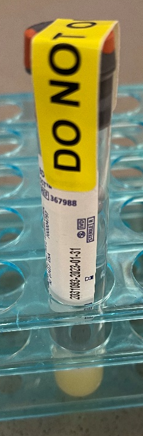
THIS SPECIMEN CANNOT BE SHARED WITH ANY OTHER TESTING. BE SURE THE TUBE IS UNOPENED AND PLACE A "DO NOT OPEN" STICKER OR TAPE OVER THE LID.
EPIC code
LAB3074
Collect
Serum separator tube
Specimen Preparation
Do not open the tube or split the specimen. Do not freeze separator tube. Do not expose specimen to air at any time during collection or transport process. Centrifuge with stopper in place within one hour of collection. Transport 5 mL serum in original serum separator tube. (Min: 0.5 mL)
Specimen Volume
5.0ML (MIN - 0.5ML)
Storage/Transport Temperature
Refrigerated. Ship upright in original serum separator collection tube and transport in the ARUP shipping rack. Do not ship on dry ice.
THIS SPECIMEN CANNOT BE SHARED WITH ANY OTHER TESTING. BE SURE THE TUBE IS UNOPENED AND PLACE A "DO NOT OPEN" STICKER OR TAPE OVER THE LID.
Notes
Differences between the ionized calcium result and the ionized calcium normalized to pH 7.4 are due to the sample having a pH significantly different from pH 7.4. Specimen pH may be artificially decreased due to delayed processing and may be increased when the specimen is exposed to air. Due to these factors, it is recommended that the ionized calcium normalized to pH 7.4 be interpreted with caution and only used when the clinician has knowledge of the patient's acid/base status. Accurate determination of in vivo pH is best determined by arterial blood gas testing.
THIS SPECIMEN CANNOT BE SHARED WITH ANY OTHER TESTING. BE SURE THE TUBE IS UNOPENED AND PLACE A "DO NOT OPEN" STICKER OR TAPE OVER THE LID.
EPIC code
LAB3074
Collect
Serum separator tube
Specimen Preparation
Do not open the tube or split the specimen. Do not freeze separator tube. Do not expose specimen to air at any time during collection or transport process. Centrifuge with stopper in place within one hour of collection. Transport 5 mL serum in original serum separator tube. (Min: 0.5 mL)
Specimen Volume
5.0ML (MIN - 0.5ML)
Storage/Transport Temperature
Refrigerated. Ship upright in original serum separator collection tube and transport in the ARUP shipping rack. Do not ship on dry ice.
THIS SPECIMEN CANNOT BE SHARED WITH ANY OTHER TESTING. BE SURE THE TUBE IS UNOPENED AND PLACE A "DO NOT OPEN" STICKER OR TAPE OVER THE LID.
Notes
Differences between the ionized calcium result and the ionized calcium normalized to pH 7.4 are due to the sample having a pH significantly different from pH 7.4. Specimen pH may be artificially decreased due to delayed processing and may be increased when the specimen is exposed to air. Due to these factors, it is recommended that the ionized calcium normalized to pH 7.4 be interpreted with caution and only used when the clinician has knowledge of the patient's acid/base status. Accurate determination of in vivo pH is best determined by arterial blood gas testing.

 Laboratories.