FFPE specimens require an Anatomic Pathology Consult. For more information call the Molecular Pathology Laboratory (215-615-3094) on weekdays during regular business hours. Questions related to ordering can be directed to the Molecular Anatomic Pathology (MAP) service at Pathway@pennmedicine.upenn.edu.
Inpatient Approval Requirements
No
Collect
Formalin fixed paraffin-embedded (FFPE) tissue that has been reviewed by an Anatomic Pathologist as adequate for molecular testing.
Specimen Preparation
FFPE Tissue: 5-10 unstained slides (5 microns) with H&E guide slides 6-9 Rolls (10 microns each) if macrodissection is not indicated
Storage/Transport Temperature
Room Temperature
Stability (from collection to initiation)
Room Temperature
Unacceptable Conditions
Decalcified paraffin-embedded tissue and paraffin-embedded tissue that has been fixed in Bouin's B5 or Zenker's; Specimens that do not contain at least 10% viable tumor; Diff-Quik slides
Remarks
This test was developed and its performance characteristics determined by the Molecular Pathology Laboratory in the Department of Pathology and Laboratory Medicine in the University of Pennsylvania Health System at the Hospital of the University of Pennsylvania 3400 Spruce Street, Philadelphia, PA 19104. It has not been cleared or approved by the US Food and Drug Administration (FDA) for certain indications. The FDA does not require this test to go through premarket FDA review. This test is used for clinical purposes. It should not be regarded as investigational or for research. This laboratory is certified under the Clinical Laboratory Improvement Amendments (CLIA) as qualified to perform high complexity clinical laboratory testing.
Processing - HUP
Do not test request.
Processing - PAH
Do not test request.
Processing - Presbyterian
Do not test request.
Reference Interval
Not Detected
Interpretive Data and Information
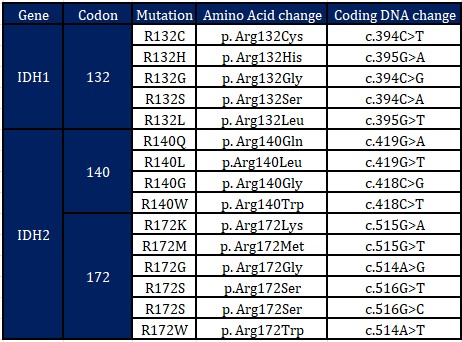
The Idylla™ IDH1-2 Mutation Assay is a real-time PCR test that detects 5 single nucleotide variants (SNVs) in IDH1 and 10 SNVs in IDH2. The table below lists the IDH1 and IDH2 variants, for each codon, detected by the assay. This assay reports a qualitative result at the codon level (i.e IDH1 Codon R132 Positive).
Testing Limitations
This qualitative assay is designed to detect 5 disease-associated variants in IDH1 and 10 disease-associated variants in IDH2, however, other rare variants at the same codons, may be detected. Since this assay does not detect all possible IDH1 or IDH2 variants, a negative result does not exclude presence of an IDH1 or IDH2 variant. If clinically indicated, testing with a more comprehensive methodology may be informative. Results are reported at the codon level, so the specific nucleotide change and corresponding amino acid change are not reported. Variant allele frequency (VAF) is not reported.
Clinical Significance
Disease-associated variants in IDH1 and IDH2, genes encoding metabolic enzymes involved in cellular aerobic respiration, are seen in 80-90% of astrocytomas and oligodendrogliomas and approximately 10% of glioblastomas. The most prevalent variant observed in diffuse gliomas is IDH1 p.R132H; however, other IDH1 and IDH2 variants have been observed. Identification of an IDH1 or IDH2 disease-associated variant is part of the diagnostic criteria for astrocytoma or oligodendroglioma according to the 2021 WHO classification of central nervous system tumors. In addition, the presence of an IDH1 or IDH2 disease-associated variant is generally associated with an improved prognosis when compared to IDH-wildtype tumors.
Variants in IDH1 and IDH2, have also been reported in 40% to 56% of central chondrosarcoma, central and periosteal chondromas, and dedifferentiated chondrosarcomas. Ollier disease and Maffucci syndrome are caused by somatic mosaic variants in IDH1 and IDH2, however this assay is not designed to distinguish between somatic (tumor) and germline events. Presence of a variant should not be equated with diagnosis of a chondroma or chondrosarcoma, and absence of a variant does not rule out these diagnoses. If clinically indicated, germline testing of IDH1 or IDH2 may be useful.
Cholangiocarcinoma (CCA) is a rare and aggressive cancer that forms in the bile ducts. Variants in IDH1 and IDH2, genes encoding metabolic enzymes involved in cellular aerobic respiration, are seen in up to 25% and 3% of CCAs, respectively. Based on results from the ClarIDHy trial, the FDA approved ivosidenib for the treatment of adult patients with unresectable locally advanced or metastatic hepatocellular IDH1-mutated CCA.
FFPE specimens require an Anatomic Pathology Consult. For more information call the Molecular Pathology Laboratory (215-615-3094) on weekdays during regular business hours. Questions related to ordering can be directed to the Molecular Anatomic Pathology (MAP) service at Pathway@pennmedicine.upenn.edu.
Inpatient Approval Requirements
No
Collect
Formalin fixed paraffin-embedded (FFPE) tissue that has been reviewed by an Anatomic Pathologist as adequate for molecular testing.
Specimen Preparation
FFPE Tissue: 5-10 unstained slides (5 microns) with H&E guide slides 6-9 Rolls (10 microns each) if macrodissection is not indicated
Storage/Transport Temperature
Room Temperature
Stability (from collection to initiation)
Room Temperature
Unacceptable Conditions
Decalcified paraffin-embedded tissue and paraffin-embedded tissue that has been fixed in Bouin's B5 or Zenker's; Specimens that do not contain at least 10% viable tumor; Diff-Quik slides
Remarks
This test was developed and its performance characteristics determined by the Molecular Pathology Laboratory in the Department of Pathology and Laboratory Medicine in the University of Pennsylvania Health System at the Hospital of the University of Pennsylvania 3400 Spruce Street, Philadelphia, PA 19104. It has not been cleared or approved by the US Food and Drug Administration (FDA) for certain indications. The FDA does not require this test to go through premarket FDA review. This test is used for clinical purposes. It should not be regarded as investigational or for research. This laboratory is certified under the Clinical Laboratory Improvement Amendments (CLIA) as qualified to perform high complexity clinical laboratory testing.
CR&P Information
Processing - HUP
Do not test request.
Processing - PAH
Do not test request.
Processing - Presbyterian
Do not test request.
Result Interpretation
Reference Interval
Not Detected
Interpretive Data and Information
The Idylla™ IDH1-2 Mutation Assay is a real-time PCR test that detects 5 single nucleotide variants (SNVs) in IDH1 and 10 SNVs in IDH2. The table below lists the IDH1 and IDH2 variants, for each codon, detected by the assay. This assay reports a qualitative result at the codon level (i.e IDH1 Codon R132 Positive).
Testing Limitations
This qualitative assay is designed to detect 5 disease-associated variants in IDH1 and 10 disease-associated variants in IDH2, however, other rare variants at the same codons, may be detected. Since this assay does not detect all possible IDH1 or IDH2 variants, a negative result does not exclude presence of an IDH1 or IDH2 variant. If clinically indicated, testing with a more comprehensive methodology may be informative. Results are reported at the codon level, so the specific nucleotide change and corresponding amino acid change are not reported. Variant allele frequency (VAF) is not reported.
Clinical Significance
Disease-associated variants in IDH1 and IDH2, genes encoding metabolic enzymes involved in cellular aerobic respiration, are seen in 80-90% of astrocytomas and oligodendrogliomas and approximately 10% of glioblastomas. The most prevalent variant observed in diffuse gliomas is IDH1 p.R132H; however, other IDH1 and IDH2 variants have been observed. Identification of an IDH1 or IDH2 disease-associated variant is part of the diagnostic criteria for astrocytoma or oligodendroglioma according to the 2021 WHO classification of central nervous system tumors. In addition, the presence of an IDH1 or IDH2 disease-associated variant is generally associated with an improved prognosis when compared to IDH-wildtype tumors.
Variants in IDH1 and IDH2, have also been reported in 40% to 56% of central chondrosarcoma, central and periosteal chondromas, and dedifferentiated chondrosarcomas. Ollier disease and Maffucci syndrome are caused by somatic mosaic variants in IDH1 and IDH2, however this assay is not designed to distinguish between somatic (tumor) and germline events. Presence of a variant should not be equated with diagnosis of a chondroma or chondrosarcoma, and absence of a variant does not rule out these diagnoses. If clinically indicated, germline testing of IDH1 or IDH2 may be useful.
Cholangiocarcinoma (CCA) is a rare and aggressive cancer that forms in the bile ducts. Variants in IDH1 and IDH2, genes encoding metabolic enzymes involved in cellular aerobic respiration, are seen in up to 25% and 3% of CCAs, respectively. Based on results from the ClarIDHy trial, the FDA approved ivosidenib for the treatment of adult patients with unresectable locally advanced or metastatic hepatocellular IDH1-mutated CCA.