Aid in the diagnosis of invasive/disseminated fungal infections (eg, P. jirovecii, Aspergillus, or Candida).
Collect
Plain red or serum separator tube (SST).
Specimen Preparation
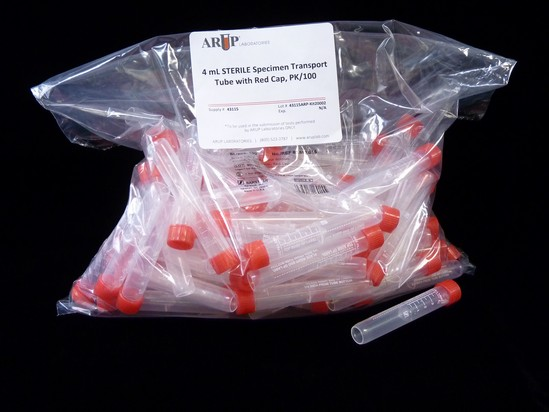
Separate from cells ASAP or within 2 hours of collection. Transfer 2 mL serum to a ARUP Sterile Transport Tube (ARUP supply # 43115) available online through eSupply using ARUP Connect(TM) or contact ARUP Client Services at 800-522-2787. (Min: 0.5 mL)
Additional Specimen Handling Instructions
**Must use STERILE ARUP Standard Transport Tube**
Storage/Transport Temperature
Refrigerated.
Unacceptable Conditions
Specimen types other than those listed. Hemolyzed, icteric, or lipemic specimens.
Aid in the diagnosis of invasive/disseminated fungal infections (eg, P. jirovecii, Aspergillus, or Candida).
EPIC Order Code
LAB4067
Sunquest Code
FNGTLS
Reference Lab Number
2002434
Synonyms
FNGTLS
LAB4067
Glucan
Beta-D glucan
Fungitell
CPT Codes
87449
LOINC
93479-4
42176-8
Reference Lab Number
2002434
Reference Interval
Components
Reference Interval
(1,3)-beta-D-glucan Interpretation
Negative
Interpretive Data
The Fungitell test is indicated for presumptive diagnosis of fungal infection and should be used in conjunction with other diagnostic procedures. This test does not detect certain fungal species such as Cryptococcus, which produce very low levels of (1,3)-beta-D-glucan. This test will not detect the zygomycetes, such as Absidia , Mucor , and Rhizopus , which are not known to produce (1,3)-beta-D-glucan. In addition, the yeast phase of Blastomyces dermatitidis produces little (1,3)-beta-D-glucan and may not be detected by the assay.
Less than 31 pg/mL
Negative
31-59 pg/mL
Negative
60-79 pg/mL
Indeterminate
Greater than or equal to 80 pg/mL
Positive
Collection
Ordering Recommendations
Aid in the diagnosis of invasive/disseminated fungal infections (eg, P. jirovecii, Aspergillus, or Candida).
Collect
Plain red or serum separator tube (SST).
Specimen Preparation
Separate from cells ASAP or within 2 hours of collection. Transfer 2 mL serum to a ARUP Sterile Transport Tube (ARUP supply # 43115) available online through eSupply using ARUP Connect(TM) or contact ARUP Client Services at 800-522-2787. (Min: 0.5 mL)
Additional Specimen Handling Instructions
**Must use STERILE ARUP Standard Transport Tube**
Storage/Transport Temperature
Refrigerated.
Unacceptable Conditions
Specimen types other than those listed. Hemolyzed, icteric, or lipemic specimens.
Aid in the diagnosis of invasive/disseminated fungal infections (eg, P. jirovecii, Aspergillus, or Candida).
EPIC Order Code
LAB4067
Sunquest Code
FNGTLS
Reference Lab Number
2002434
Synonyms
FNGTLS
LAB4067
Glucan
Beta-D glucan
Fungitell
Fees & Codes
CPT Codes
87449
LOINC
93479-4
42176-8
Reference Lab Number
2002434
Clinical & Interpretive
Reference Interval
Components
Reference Interval
(1,3)-beta-D-glucan Interpretation
Negative
Interpretive Data
The Fungitell test is indicated for presumptive diagnosis of fungal infection and should be used in conjunction with other diagnostic procedures. This test does not detect certain fungal species such as Cryptococcus, which produce very low levels of (1,3)-beta-D-glucan. This test will not detect the zygomycetes, such as Absidia , Mucor , and Rhizopus , which are not known to produce (1,3)-beta-D-glucan. In addition, the yeast phase of Blastomyces dermatitidis produces little (1,3)-beta-D-glucan and may not be detected by the assay.

 Laboratories.