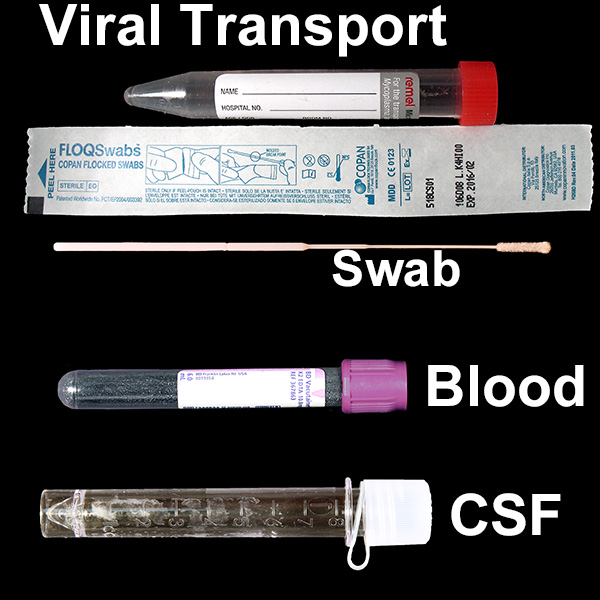
Blood, Lavender
CSF, CSF Tube
Swab, Viral Transport
Preferred Draw Volume
Whole Blood: 2 mL, pediatrics 1 mL
Plasma: 200 µl
CSF and Viral transport media: 50 µl
Minimum Draw Volume
Minimum 200 µl is required for plasma
Minimum 50 µl is required for testing CSF and swabs in viral transport media
Pediatric Collection
1 Full Microtainer
Unacceptable Conditions
Plasma not separated within 6 hours of collection
No heparin or clotted samples.
Collection Comments
For swabs: must collect from a vesicle/lesion, then place in viral transport media.
For blood specimens: submit 1 mL plasma or 5 mL whole blood. Pediatric minimum 0.25 mL plasma or CSF; 0.5 mL plasma or CSF to be able to perform a repeat.
Specimen must be labeled with patient's full name, ID number, birth date and date and time of collection. Process within 6 hours of collection. If collected in lavender, spin for 20 minutes at 1600 g. Transfer plasma to an aliquot tube. Remember to properly label tube with patient name, DOB, test and collect date.
Storage/Transport Temperature
Refrigerated
Stability (from collection to initiation)
Room Temperature: not recommended
Refrigerated Plasma: 5 days
Frozen Plasma: >5 days
Special Handling
Blood: Spin within 6 hours, Refrigerate
Ordering Recommendations
Herpes simplex virus (HSV) types 1 and 2 are capable of producing a broad range of infections associated with skin, mucous membranes, eye, central nervous system, and occasionally internal organs in both normal and immunocompromised patients. They induce a lifelong latent infection and are capable of inducing recurrent infections. The course of infection and symptoms produced are dependent on the site of infection, age, and immune status of the host and serotype of the virus. HSV infections of the central nervous system (CNS) affect all ages of patients and can occur any time during the year. These include neonatal HSV infections, HSV encephalitis, and recurrent aseptic meningitis (Mollaret's meningitis). Qualitative PCR is particularly useful due to temperature liability for culture, which HSV is rarely recovered from CSF through culture, and time delay between collection and culture for HSV could result in false negative results.
Performed
Monday - Friday; Days, Evenings
Saturday - Sunday; Days
Methodology
Real-time polymerase chain reaction (PCR)
Reported
1-2 days
Performing Lab
Molecular
Synonyms
3105
HSV 1/2 DNA BY PCR
HSV CSF PCR
HSV PCR
HSV12RT
Herpes Simplex 1/2 DNA by PCR
Herpes Simplex Virus (HSV) 1 & 2 RT-PCR
Reference Interval
Not detected
CPT Codes
87529 x 2
LOINC Codes
NAME
LOINC
Order
HSV 1,2 DNA QL by Real-Time PCR
20444-6
Result
HSV 1 DNA Real-Time PCR
16130-7
HSV 2 DNA Real-Time PCR
16131-5
Test Code (Outreach Synonym)
3105
Catalog Code
109922324
Collection
Collect
Blood, Lavender
CSF, CSF Tube
Swab, Viral Transport
Preferred Draw Volume
Whole Blood: 2 mL, pediatrics 1 mL
Plasma: 200 µl
CSF and Viral transport media: 50 µl
Minimum Draw Volume
Minimum 200 µl is required for plasma
Minimum 50 µl is required for testing CSF and swabs in viral transport media
Pediatric Collection
1 Full Microtainer
Unacceptable Conditions
Plasma not separated within 6 hours of collection
No heparin or clotted samples.
Collection Comments
For swabs: must collect from a vesicle/lesion, then place in viral transport media.
For blood specimens: submit 1 mL plasma or 5 mL whole blood. Pediatric minimum 0.25 mL plasma or CSF; 0.5 mL plasma or CSF to be able to perform a repeat.
Specimen must be labeled with patient's full name, ID number, birth date and date and time of collection. Process within 6 hours of collection. If collected in lavender, spin for 20 minutes at 1600 g. Transfer plasma to an aliquot tube. Remember to properly label tube with patient name, DOB, test and collect date.
Storage/Transport Temperature
Refrigerated
Stability (from collection to initiation)
Room Temperature: not recommended
Refrigerated Plasma: 5 days
Frozen Plasma: >5 days
Special Handling
Blood: Spin within 6 hours, Refrigerate
Ordering
Ordering Recommendations
Herpes simplex virus (HSV) types 1 and 2 are capable of producing a broad range of infections associated with skin, mucous membranes, eye, central nervous system, and occasionally internal organs in both normal and immunocompromised patients. They induce a lifelong latent infection and are capable of inducing recurrent infections. The course of infection and symptoms produced are dependent on the site of infection, age, and immune status of the host and serotype of the virus. HSV infections of the central nervous system (CNS) affect all ages of patients and can occur any time during the year. These include neonatal HSV infections, HSV encephalitis, and recurrent aseptic meningitis (Mollaret's meningitis). Qualitative PCR is particularly useful due to temperature liability for culture, which HSV is rarely recovered from CSF through culture, and time delay between collection and culture for HSV could result in false negative results.
Performed
Monday - Friday; Days, Evenings
Saturday - Sunday; Days