
Collect

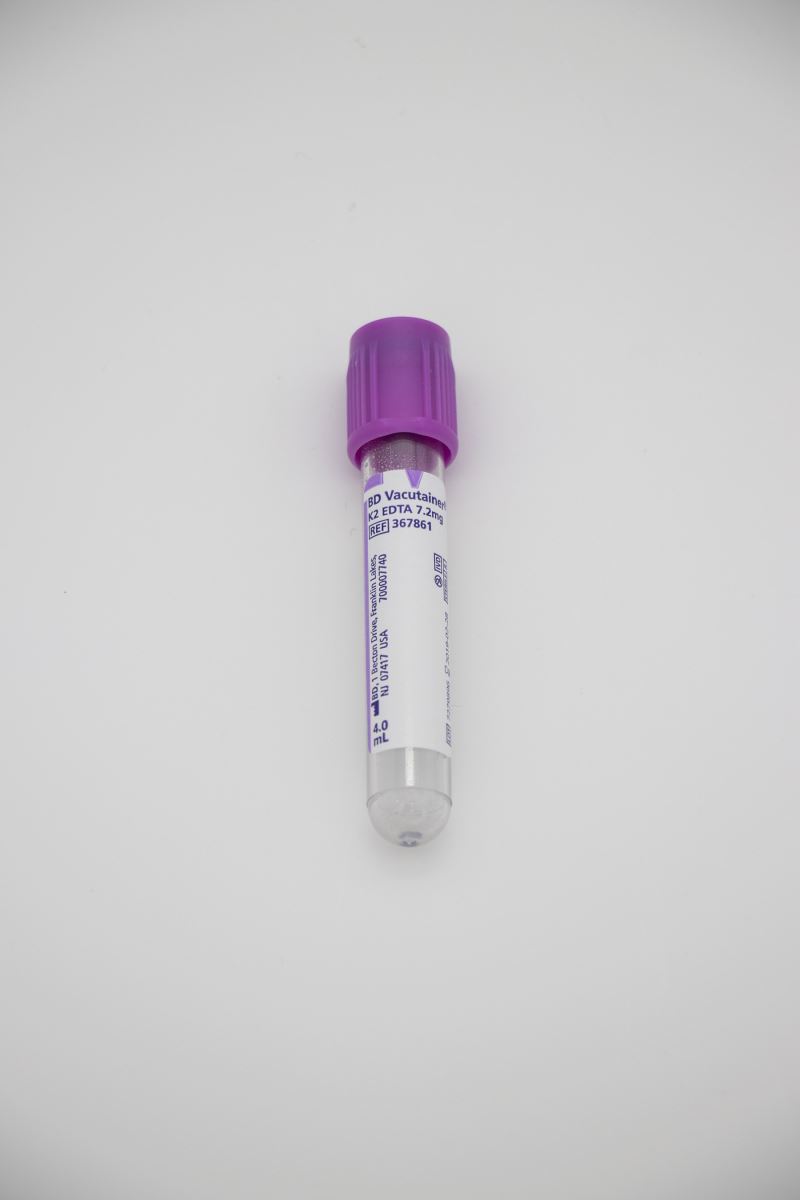
Collect whole blood in a purple top (EDTA) tube (preferred). Extracted DNA is also acceptable.

For fetal specimens, 10 mL minimum of amniotic fluid is required.

Specimen Preparation

Family Member Samples: For optimal analysis, submission of comparator samples is highly recommended. Please see the Rapid Targeted Analysis of Family Member order for ordering tests on other family members.

Unacceptable Conditions

Heparinized specimens, severely hemolyzed specimens, certain non-blood samples with contaminating blood (e.g. amniotic fluid), frozen, clotted or possibly commingled specimens, samples in non-sterile or leaky containers, mislabeled or inappropriately labeled specimens.

We cannot accept saliva samples or cord blood from probands at this time.

Storage/Transport Temperature

For CHOP Phlebotomy: Samples can be collected throughout the week.

Samples collected from inpatient units after hours, on weekends or holidays are held in Central Labs and sent to the Genomic Diagnostic Lab the following business day.

For External Clients: Please contact the Clinical Lab Outreach team before sending a sample for this test: ClinicalLabOutreach@chop.edu. Refrigerate sample until shipment. Send the sample at room temperature with overnight delivery for receipt Monday through Friday, optimally within 24 hours of collection.

Please contact the lab (267-426-1447) with questions regarding non-blood specimens.

Volume Required

2-3 mL of blood or 3 µg of DNA with a concentration of at least 50 ng/µl

For fetal specimens: 10-20 mL Amniotic Fluid

Minimum Required

1 mL of whole blood

For fetal specimens: 10mL Amniotic Fluid

Phlebotomy Draw

Yes

Clinical Features

The Rapid Targeted Analysis of Genome - Infant (rTAG-I) test is a next generation sequencing test designed to identify clinically significant single nucleotide variants, copy number variants, and select repeat expansions that may provide information about diagnosis, management, and/or prognosis for disorders with prenatal, infantile, and/or early pediatric onset. 

Ordering Recommendations

Ordering of this test is restricted to fetal specimens and specimens from infants <13 months of age in an inpatient unit of the Children’s Hospital of Philadelphia.

For External Clients: Please contact the Clinical Lab Outreach team before sending a sample for this test: ClinicalLabOutreach@chop.edu.

Use Rapid Targeted Analysis of Family Member for family members undergoing evaluation to directly assist in interpretation of the patient's sequencing data.

Performing Lab

Division of Genomic Diagnostics

Performed

Monday-Friday 9:00am - 4:00pm

Methodology

TEST SPECIFIC INFORMATION

The Rapid Targeted Analysis of Genome - Infant (rTAG-I) test is a next generation sequencing test designed to identify clinically significant single nucleotide variants, copy number variants, and select repeat expansions that may provide information about diagnosis, management, and/or prognosis for disorders with prenatal, infantile, and/or early pediatric onset.

The rTAG-I analyzes approximately 3500 genes associated with infantile-onset conditions (version 4.0). Microdeletion/duplication syndromes and large cytogenetic findings with anticipated infantile onset are also included in the analysis in addition to repeat expansions in DMPK, FMR1, FXN and PHOX2B

For a full list of genes and cytogenetic syndromes assessed, see rTAG-I gene/cytogenetic syndromes version list.

Next Generation Sequencing: Genomic DNA is extracted from patient tissue following standard DNA extraction protocols. Whole genome sequencing is performed on the Illumina NovaSeq X Plus platform using the Illumina DNA PCR-Free Library Prep with 150bp paired-end reads. Sequencing data is processed using the Dragen pipeline (Illumina) to call sequence variants, copy number variants, and select repeat expansion disorders (DMPK, FMR1, FXN, PHOX2B). 

Variant analysis and filtration: The rTAG-I test evaluates only the targeted genes and cytogenetic regions included on this test. This test prioritizes the analysis of coding exons but may include known variants in regulatory and intronic regions. Variants in the untranslated and deep intronic regions are only analyzed if they are known disease-causing variants (e.g., as reported in HGMD and ClinVar).

Confirmation policy: As necessary, Sanger sequencing, droplet digital PCR (ddPCR), or another methodology is used to confirm reported variants.

Results Reporting: An rTAG-I report is only written for the proband; however, inheritance of reportable variants is included when parents are available for analysis and results are clinically relevant. This analysis prioritizes the identification of clinically significant findings (e.g., pathogenic and likely pathogenic variants that are de novo, heterozygous, homozygous, and compound heterozygous) and limits the reporting of variants that appear unlikely (or are uncertain) to cause clinically significant disease. This test is not designed to identify or report risk alleles or variants common in the general population associated with genetic disease.

Each rare sequence and copy number variant in the targeted genes is evaluated based on the currently available information from relevant resources, such as clinical and population variant databases and the scientific literature. Variants are classified using criteria consistent with those recommended by the American College of Medical Genetics and Genomics (ACMG) [Richards 2015, PMID: 25741868] and reported using HGVS or ISCN nomenclature [den Dunnen 2016, PMID: 26931183; ISCN 2020].

Variants are reported if they are classified as likely pathogenic or pathogenic. Variants of uncertain significance may be reported, for example when identified in a gene known to cause an autosomal recessive disorder and in combination with a second pathogenic or likely pathogenic variant. Variants in genes associated with both dominant and recessive phenotypes are classified independently for each inheritance pattern when applicable and reported if the disorder falls within the targeted genes/cytogenetic syndromes included on this test.

Reportable copy number variants that involve a targeted gene may include adjacent non-targeted genes.

Variants consistent with pathogenic repeat expansions as outlined below will be reported on the rTAG-I. Pre-Mutation alleles will not routinely be reported.  

Reporting Criteria – Repeat Expansion Disorders:
GenePathogenic Variant Range (No. repeats)Pre-Mutation Variant Range
DMPK≥50n/a
FMR1>20055-200
FXN≥66n/a
PHOX2B≥24n/a


LIMITATIONS

A negative result does not exclude the possibility that a proband harbors a pathogenic variant that was undetectable by this test due to the technical limitations. The analysis depends on scientific knowledge of genetic disease at the time of analysis. Medical knowledge for many human genes is incomplete, and therefore, there likely are disease-causing genes not included in this analysis. There may also be variants in targeted genes that are not known at the time of analysis to cause disease. The majority of variants of uncertain significance identified in genes of interest are not reportable for this test. Clinical implications of some variants may be uncertain or unknown at the time of this report and may change over time. The possibility that alterations classified as benign or likely benign could contribute to disease risk in an unforeseen manner cannot be excluded. This test does not include analysis of genes or regions beyond the scope specified in the Test Specific Information and Methodology sections above. Interpretations are made with the assumption that familial relationships provided to the laboratory are accurate.

The chance of a false negative or false positive result cannot be completely excluded due to error during any phase of testing including sample collection, transport and processing, bioinformatic prioritization, and variant classification and reporting.

This analysis may not identify certain types of variants, such as mosaic variants, some copy number variants, structural variants, or other long segments of repetitive DNA.

Reported

Preliminary verbal in 7 days; final report in 14 days.

Synonyms

  • rTAG, rTAG infant, rTAG-I, RTAGI, Rapid Targeted Analysis of Genome, Baby Eagle, NICU sequencing, infant sequencing

LIS Mnemonic

RTAGI

Available STAT

No

CPT Codes

81443

Billing (EAP) Codes

808681
Collection

Collect

Collect whole blood in a purple top (EDTA) tube (preferred). Extracted DNA is also acceptable.

For fetal specimens, 10 mL minimum of amniotic fluid is required.

Specimen Preparation

Family Member Samples: For optimal analysis, submission of comparator samples is highly recommended. Please see the Rapid Targeted Analysis of Family Member order for ordering tests on other family members.

Unacceptable Conditions

Heparinized specimens, severely hemolyzed specimens, certain non-blood samples with contaminating blood (e.g. amniotic fluid), frozen, clotted or possibly commingled specimens, samples in non-sterile or leaky containers, mislabeled or inappropriately labeled specimens.

We cannot accept saliva samples or cord blood from probands at this time.

Storage/Transport Temperature

For CHOP Phlebotomy: Samples can be collected throughout the week.

Samples collected from inpatient units after hours, on weekends or holidays are held in Central Labs and sent to the Genomic Diagnostic Lab the following business day.

For External Clients: Please contact the Clinical Lab Outreach team before sending a sample for this test: ClinicalLabOutreach@chop.edu. Refrigerate sample until shipment. Send the sample at room temperature with overnight delivery for receipt Monday through Friday, optimally within 24 hours of collection.

Please contact the lab (267-426-1447) with questions regarding non-blood specimens.

Volume Required

2-3 mL of blood or 3 µg of DNA with a concentration of at least 50 ng/µl

For fetal specimens: 10-20 mL Amniotic Fluid

Minimum Required

1 mL of whole blood

For fetal specimens: 10mL Amniotic Fluid

Phlebotomy Draw

Yes
Ordering

Clinical Features

The Rapid Targeted Analysis of Genome - Infant (rTAG-I) test is a next generation sequencing test designed to identify clinically significant single nucleotide variants, copy number variants, and select repeat expansions that may provide information about diagnosis, management, and/or prognosis for disorders with prenatal, infantile, and/or early pediatric onset. 

Ordering Recommendations

Ordering of this test is restricted to fetal specimens and specimens from infants <13 months of age in an inpatient unit of the Children’s Hospital of Philadelphia.

For External Clients: Please contact the Clinical Lab Outreach team before sending a sample for this test: ClinicalLabOutreach@chop.edu.

Use Rapid Targeted Analysis of Family Member for family members undergoing evaluation to directly assist in interpretation of the patient's sequencing data.

Performing Lab

Division of Genomic Diagnostics

Performed

Monday-Friday 9:00am - 4:00pm

Methodology

TEST SPECIFIC INFORMATION

The Rapid Targeted Analysis of Genome - Infant (rTAG-I) test is a next generation sequencing test designed to identify clinically significant single nucleotide variants, copy number variants, and select repeat expansions that may provide information about diagnosis, management, and/or prognosis for disorders with prenatal, infantile, and/or early pediatric onset.

The rTAG-I analyzes approximately 3500 genes associated with infantile-onset conditions (version 4.0). Microdeletion/duplication syndromes and large cytogenetic findings with anticipated infantile onset are also included in the analysis in addition to repeat expansions in DMPK, FMR1, FXN and PHOX2B

For a full list of genes and cytogenetic syndromes assessed, see rTAG-I gene/cytogenetic syndromes version list.

Next Generation Sequencing: Genomic DNA is extracted from patient tissue following standard DNA extraction protocols. Whole genome sequencing is performed on the Illumina NovaSeq X Plus platform using the Illumina DNA PCR-Free Library Prep with 150bp paired-end reads. Sequencing data is processed using the Dragen pipeline (Illumina) to call sequence variants, copy number variants, and select repeat expansion disorders (DMPK, FMR1, FXN, PHOX2B). 

Variant analysis and filtration: The rTAG-I test evaluates only the targeted genes and cytogenetic regions included on this test. This test prioritizes the analysis of coding exons but may include known variants in regulatory and intronic regions. Variants in the untranslated and deep intronic regions are only analyzed if they are known disease-causing variants (e.g., as reported in HGMD and ClinVar).

Confirmation policy: As necessary, Sanger sequencing, droplet digital PCR (ddPCR), or another methodology is used to confirm reported variants.

Results Reporting: An rTAG-I report is only written for the proband; however, inheritance of reportable variants is included when parents are available for analysis and results are clinically relevant. This analysis prioritizes the identification of clinically significant findings (e.g., pathogenic and likely pathogenic variants that are de novo, heterozygous, homozygous, and compound heterozygous) and limits the reporting of variants that appear unlikely (or are uncertain) to cause clinically significant disease. This test is not designed to identify or report risk alleles or variants common in the general population associated with genetic disease.

Each rare sequence and copy number variant in the targeted genes is evaluated based on the currently available information from relevant resources, such as clinical and population variant databases and the scientific literature. Variants are classified using criteria consistent with those recommended by the American College of Medical Genetics and Genomics (ACMG) [Richards 2015, PMID: 25741868] and reported using HGVS or ISCN nomenclature [den Dunnen 2016, PMID: 26931183; ISCN 2020].

Variants are reported if they are classified as likely pathogenic or pathogenic. Variants of uncertain significance may be reported, for example when identified in a gene known to cause an autosomal recessive disorder and in combination with a second pathogenic or likely pathogenic variant. Variants in genes associated with both dominant and recessive phenotypes are classified independently for each inheritance pattern when applicable and reported if the disorder falls within the targeted genes/cytogenetic syndromes included on this test.

Reportable copy number variants that involve a targeted gene may include adjacent non-targeted genes.

Variants consistent with pathogenic repeat expansions as outlined below will be reported on the rTAG-I. Pre-Mutation alleles will not routinely be reported.  

Reporting Criteria – Repeat Expansion Disorders:
GenePathogenic Variant Range (No. repeats)Pre-Mutation Variant Range
DMPK≥50n/a
FMR1>20055-200
FXN≥66n/a
PHOX2B≥24n/a


LIMITATIONS

A negative result does not exclude the possibility that a proband harbors a pathogenic variant that was undetectable by this test due to the technical limitations. The analysis depends on scientific knowledge of genetic disease at the time of analysis. Medical knowledge for many human genes is incomplete, and therefore, there likely are disease-causing genes not included in this analysis. There may also be variants in targeted genes that are not known at the time of analysis to cause disease. The majority of variants of uncertain significance identified in genes of interest are not reportable for this test. Clinical implications of some variants may be uncertain or unknown at the time of this report and may change over time. The possibility that alterations classified as benign or likely benign could contribute to disease risk in an unforeseen manner cannot be excluded. This test does not include analysis of genes or regions beyond the scope specified in the Test Specific Information and Methodology sections above. Interpretations are made with the assumption that familial relationships provided to the laboratory are accurate.

The chance of a false negative or false positive result cannot be completely excluded due to error during any phase of testing including sample collection, transport and processing, bioinformatic prioritization, and variant classification and reporting.

This analysis may not identify certain types of variants, such as mosaic variants, some copy number variants, structural variants, or other long segments of repetitive DNA.

Reported

Preliminary verbal in 7 days; final report in 14 days.

Synonyms

  • rTAG, rTAG infant, rTAG-I, RTAGI, Rapid Targeted Analysis of Genome, Baby Eagle, NICU sequencing, infant sequencing

LIS Mnemonic

RTAGI

Available STAT

No
Result Interpretation
Administrative

CPT Codes

81443

Billing (EAP) Codes

808681