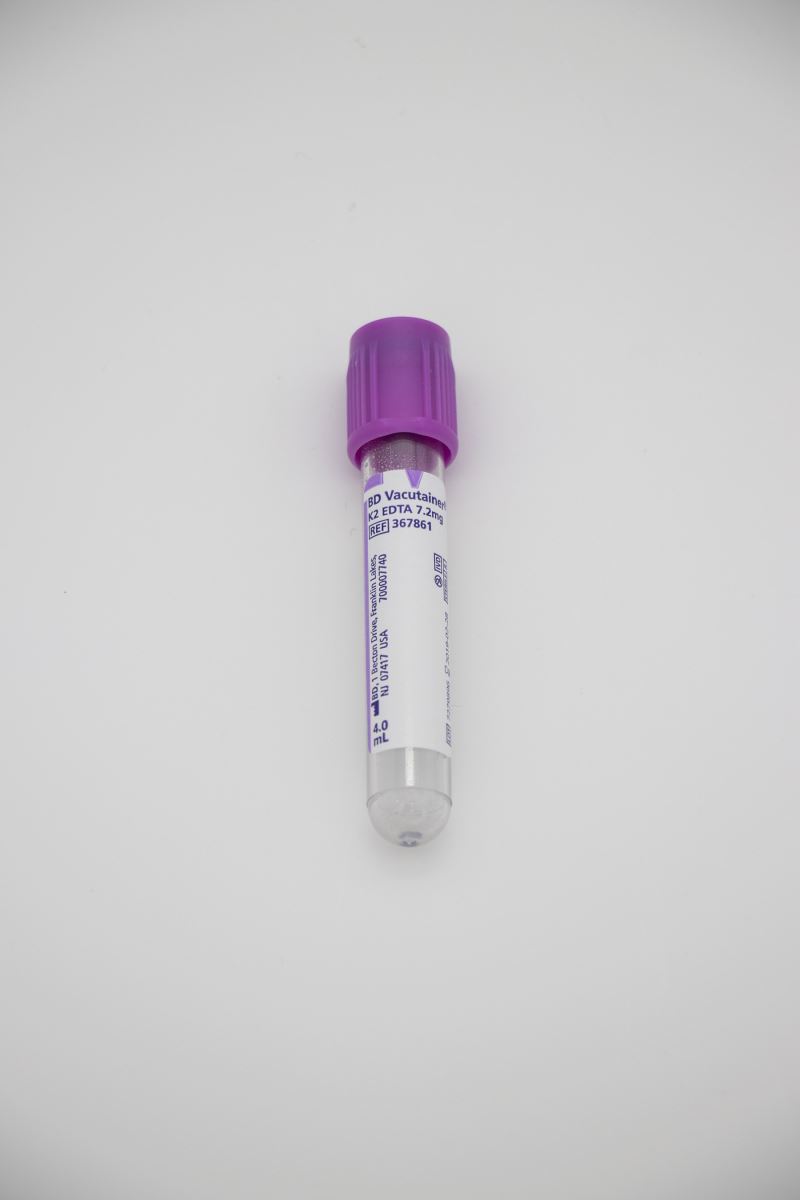
Whole blood in a purple top (EDTA) tube (preferred). Extracted DNA and saliva are also acceptable.
Unacceptable Conditions
Heparinized specimens, severely hemolyzed specimens, frozen, clotted or possibly commingled specimens, blood in non-sterile or leaky containers, mislabeled or inappropriately labeled specimens.
Storage/Transport Temperature
For CHOP Phlebotomy: Samples can be collected throughout the week. Samples collected on weekends or holidays are held in Central Labs and sent to the Genomic Diagnostic Lab the following business day.
For External Clients: Refrigerate sample until shipment. Send the sample at room temperature with overnight delivery for receipt Monday through Friday, optimally within 24 hours of collection.
Please contact the lab (267-426-1447) with questions regarding non-blood specimens.
Volume Required
5 ml whole blood or 1 ug extracted DNA
Minimum Required
3 ml whole blood
Phlebotomy Draw
Yes
Clinical Features
Craniofrontonasal syndrome (CFNS) is an X-linked dominant disorder whose main clinical manifestations include coronal synostosis, hypertelorism, clefting of the nasal tip and various skeletal anomalies. Expression of CFNS is more severe in heterozygous females than in hemizygous males. Heterozygous females can display multiple cranial and extra-cranial features including, but not limited to: craniofacial asymmetry, craniosynostosis, bifid nasal tip, hypertelorism, and abnormalities of the thoracic skeleton and digits. Hemizygous males have no or only mild manifestations such as hypertelorism.
Performing Lab
Division of Genomic Diagnostics
Performed
Mon - Fri 9:00am to 4:00pm
Reported
28 days
Detection Rate
The analytical sensitivity of MLPA is ~99%.
Utility
The clinical utility of the assay is to support a clinical diagnosis of the disease, facilitate genetic counseling, assess the risk to other first degree relatives and to facilitate testing of at-risk family members.
Large deletions in the EFNB1 gene will be detected using a multiplex ligation-dependent probe amplification assay (MLPA).
Molecular Testing Notes
Loss-of-function mutations in EFNB1 located in Xq13.1 cause CFNS. Published mutations include frameshift, nonsense, missense, splice-site mutations, and partial/whole gene deletions. Mutations have been identified in all 5 exons, however more than half of mutations are located in exon 2. Somatic mosaicism has been described in 10-15% of families; thus, it may not always be possible to detect the pathogenic EFNB1 mutation in the first affected family member.
CPT Codes
81479
Collection
Collect
Whole blood in a purple top (EDTA) tube (preferred). Extracted DNA and saliva are also acceptable.
Unacceptable Conditions
Heparinized specimens, severely hemolyzed specimens, frozen, clotted or possibly commingled specimens, blood in non-sterile or leaky containers, mislabeled or inappropriately labeled specimens.
Storage/Transport Temperature
For CHOP Phlebotomy: Samples can be collected throughout the week. Samples collected on weekends or holidays are held in Central Labs and sent to the Genomic Diagnostic Lab the following business day.
For External Clients: Refrigerate sample until shipment. Send the sample at room temperature with overnight delivery for receipt Monday through Friday, optimally within 24 hours of collection.
Please contact the lab (267-426-1447) with questions regarding non-blood specimens.
Volume Required
5 ml whole blood or 1 ug extracted DNA
Minimum Required
3 ml whole blood
Phlebotomy Draw
Yes
Ordering
Clinical Features
Craniofrontonasal syndrome (CFNS) is an X-linked dominant disorder whose main clinical manifestations include coronal synostosis, hypertelorism, clefting of the nasal tip and various skeletal anomalies. Expression of CFNS is more severe in heterozygous females than in hemizygous males. Heterozygous females can display multiple cranial and extra-cranial features including, but not limited to: craniofacial asymmetry, craniosynostosis, bifid nasal tip, hypertelorism, and abnormalities of the thoracic skeleton and digits. Hemizygous males have no or only mild manifestations such as hypertelorism.
Performing Lab
Division of Genomic Diagnostics
Performed
Mon - Fri 9:00am to 4:00pm
Reported
28 days
Detection Rate
The analytical sensitivity of MLPA is ~99%.
Utility
The clinical utility of the assay is to support a clinical diagnosis of the disease, facilitate genetic counseling, assess the risk to other first degree relatives and to facilitate testing of at-risk family members.
Large deletions in the EFNB1 gene will be detected using a multiplex ligation-dependent probe amplification assay (MLPA).
Molecular Testing Notes
Loss-of-function mutations in EFNB1 located in Xq13.1 cause CFNS. Published mutations include frameshift, nonsense, missense, splice-site mutations, and partial/whole gene deletions. Mutations have been identified in all 5 exons, however more than half of mutations are located in exon 2. Somatic mosaicism has been described in 10-15% of families; thus, it may not always be possible to detect the pathogenic EFNB1 mutation in the first affected family member.