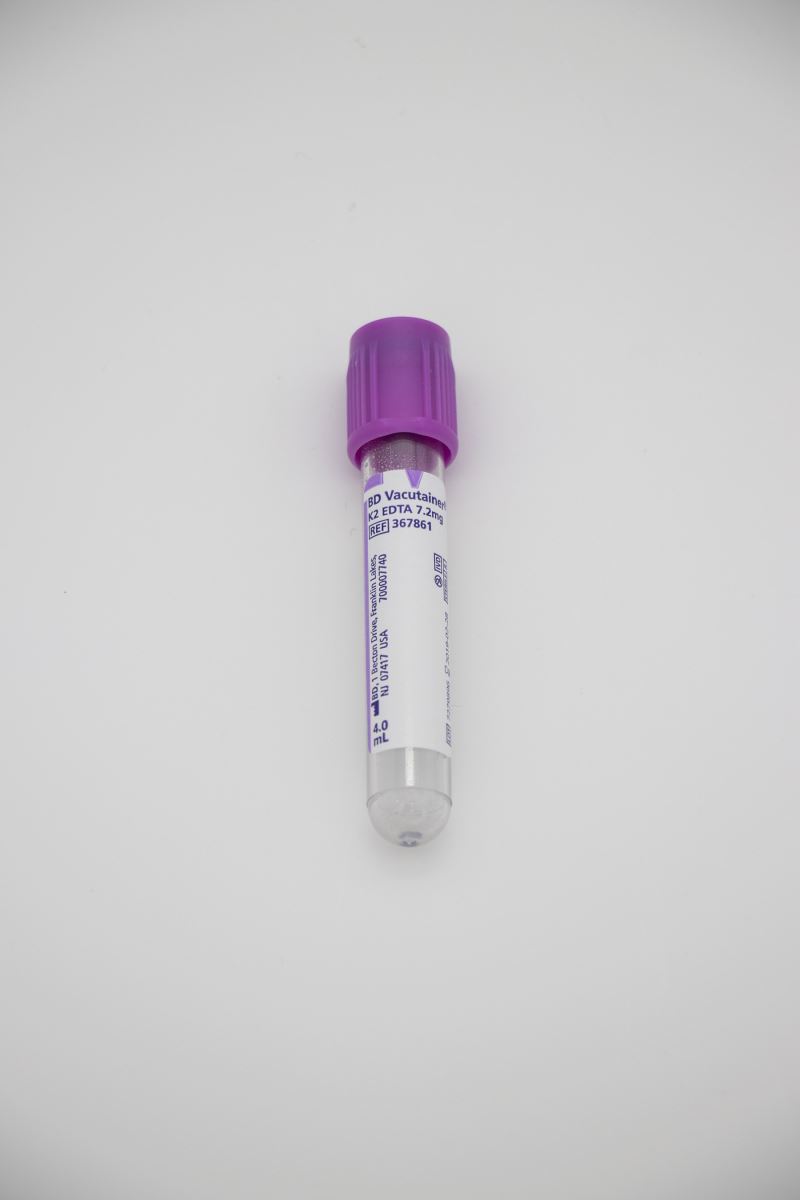
Collect whole blood in a purple top (EDTA) tube (preferred). Extracted DNA and saliva are also acceptable.
Unacceptable Conditions
Heparinized specimens, severely hemolyzed specimens, frozen, clotted or possibly commingled specimens, blood in non-sterile or leaky containers, mislabeled or inappropriately labeled specimens.
Storage/Transport Temperature
For CHOP Phlebotomy: Samples can be collected throughout the week. Samples collected on weekends or holidays are held in Central Labs and sent to the Genomic Diagnostic Lab the following business day.
For External Clients: Refrigerate sample until shipment. Send the sample at room temperature with overnight delivery for receipt Monday through Friday, optimally within 24 hours of collection.
Please contact the lab (267-426-1447) with questions regarding non-blood specimens.
Volume Required
5 ml whole blood or 3 ug extracted DNA
Minimum Required
3 ml whole blood or 1 ug extracted DNA
Phlebotomy Draw
Yes
Clinical Features
Germline mutations in the PTEN gene have been identified in Cowden syndrome, Bannayan-Riley-Ruvalcaba Syndrome, Proteus syndrome and Proteus-like syndrome, now collectively referred to as PTEN Hamartoma Tumor Syndrome (PHTS). Cowden syndrome (CS-MIM 158350) is a multiple hamartoma syndrome with a high risk of breast, thyroid and endometrial cancer. Bannayan-Riley-Ruvalcaba Syndrome (BRRS-MIM 153480) is characterized by macrocephaly, intestinal hamartomatous polyposis, lipomas, and pigmented macules of the glans penis in males. Proteus syndrome (PS-MIM 176920) is a highly variable disorder involving disproportionate overgrowth of multiple tissues, as well as connective tissue nevi, epidermal nevi, and hyperostoses. Although PTEN is most recognized for its role in carcinogenesis, germline mutations in PTEN have been identified in children with autism and significant macrocephaly with a parent affected with CS or BRRS . Subsequently, additional studies have reported PTEN mutations in children affected with significant macrocephaly and autism.
Performing Lab
Division of Genomic Diagnostics
Performed
Mon - Fri 9:00am to 4:00pm
Reported
28 days
Detection Rate
A number of studies have demonstrated that germline mutations in the PTEN gene are present in 10-20% of individuals with autism spectrum disorders and macrocephaly.
Utility
The clinical utility of the assay is to support a clinical diagnosis of the disease, facilitate genetic counseling, and assess the risk to other first degree relatives and to facilitate testing of at-risk family members.
Synonyms
Autism Spectrum of Disorders, Macrocephaly, Hamartoma
PTENM
LIS Mnemonic
PTENM
Available STAT
No
Reflex Testing
For sequential analysis, order: PTEN Seq Analysis; if NEGATIVE, reflex to PTEN Del/Dup.
Test Notes
We offer deletion/duplication testing of the entire coding region of the PTEN gene using multiplex ligation-dependent probe amplification assay (MLPA). PCR amplification and sequence analysis is performed on the coding exons including splice junctions. The patient's gene sequence is compared to a reference sequence. Sequence variants are classified as mutations, variants of unknown significance or benign variants unrelated to disease. Variants of unknown significance may warrant further studies in the patient and other family members. Mutations in promoters, deep intronic regions and other regulatory regions will not be identified with this assay.
Molecular Testing Notes
The phosphatase and tensin homologue deleted on chromosome 10 (PTEN) gene (MIM 601728) is a tumor suppressor gene located on chromosome 10q23.3. It functions as a dual-specificity phosphatase that is active in numerous pathways involved with cellular growth. Missense, nonsense, splice site mutations, indels and large deletions have been identified in this gene.
CPT Codes
81323
Collection
Collect
Collect whole blood in a purple top (EDTA) tube (preferred). Extracted DNA and saliva are also acceptable.
Unacceptable Conditions
Heparinized specimens, severely hemolyzed specimens, frozen, clotted or possibly commingled specimens, blood in non-sterile or leaky containers, mislabeled or inappropriately labeled specimens.
Storage/Transport Temperature
For CHOP Phlebotomy: Samples can be collected throughout the week. Samples collected on weekends or holidays are held in Central Labs and sent to the Genomic Diagnostic Lab the following business day.
For External Clients: Refrigerate sample until shipment. Send the sample at room temperature with overnight delivery for receipt Monday through Friday, optimally within 24 hours of collection.
Please contact the lab (267-426-1447) with questions regarding non-blood specimens.
Volume Required
5 ml whole blood or 3 ug extracted DNA
Minimum Required
3 ml whole blood or 1 ug extracted DNA
Phlebotomy Draw
Yes
Ordering
Clinical Features
Germline mutations in the PTEN gene have been identified in Cowden syndrome, Bannayan-Riley-Ruvalcaba Syndrome, Proteus syndrome and Proteus-like syndrome, now collectively referred to as PTEN Hamartoma Tumor Syndrome (PHTS). Cowden syndrome (CS-MIM 158350) is a multiple hamartoma syndrome with a high risk of breast, thyroid and endometrial cancer. Bannayan-Riley-Ruvalcaba Syndrome (BRRS-MIM 153480) is characterized by macrocephaly, intestinal hamartomatous polyposis, lipomas, and pigmented macules of the glans penis in males. Proteus syndrome (PS-MIM 176920) is a highly variable disorder involving disproportionate overgrowth of multiple tissues, as well as connective tissue nevi, epidermal nevi, and hyperostoses. Although PTEN is most recognized for its role in carcinogenesis, germline mutations in PTEN have been identified in children with autism and significant macrocephaly with a parent affected with CS or BRRS . Subsequently, additional studies have reported PTEN mutations in children affected with significant macrocephaly and autism.
Performing Lab
Division of Genomic Diagnostics
Performed
Mon - Fri 9:00am to 4:00pm
Reported
28 days
Detection Rate
A number of studies have demonstrated that germline mutations in the PTEN gene are present in 10-20% of individuals with autism spectrum disorders and macrocephaly.
Utility
The clinical utility of the assay is to support a clinical diagnosis of the disease, facilitate genetic counseling, and assess the risk to other first degree relatives and to facilitate testing of at-risk family members.
Synonyms
Autism Spectrum of Disorders, Macrocephaly, Hamartoma
PTENM
LIS Mnemonic
PTENM
Available STAT
No
Reflex Testing
For sequential analysis, order: PTEN Seq Analysis; if NEGATIVE, reflex to PTEN Del/Dup.
Test Notes
We offer deletion/duplication testing of the entire coding region of the PTEN gene using multiplex ligation-dependent probe amplification assay (MLPA). PCR amplification and sequence analysis is performed on the coding exons including splice junctions. The patient's gene sequence is compared to a reference sequence. Sequence variants are classified as mutations, variants of unknown significance or benign variants unrelated to disease. Variants of unknown significance may warrant further studies in the patient and other family members. Mutations in promoters, deep intronic regions and other regulatory regions will not be identified with this assay.
Molecular Testing Notes
The phosphatase and tensin homologue deleted on chromosome 10 (PTEN) gene (MIM 601728) is a tumor suppressor gene located on chromosome 10q23.3. It functions as a dual-specificity phosphatase that is active in numerous pathways involved with cellular growth. Missense, nonsense, splice site mutations, indels and large deletions have been identified in this gene.