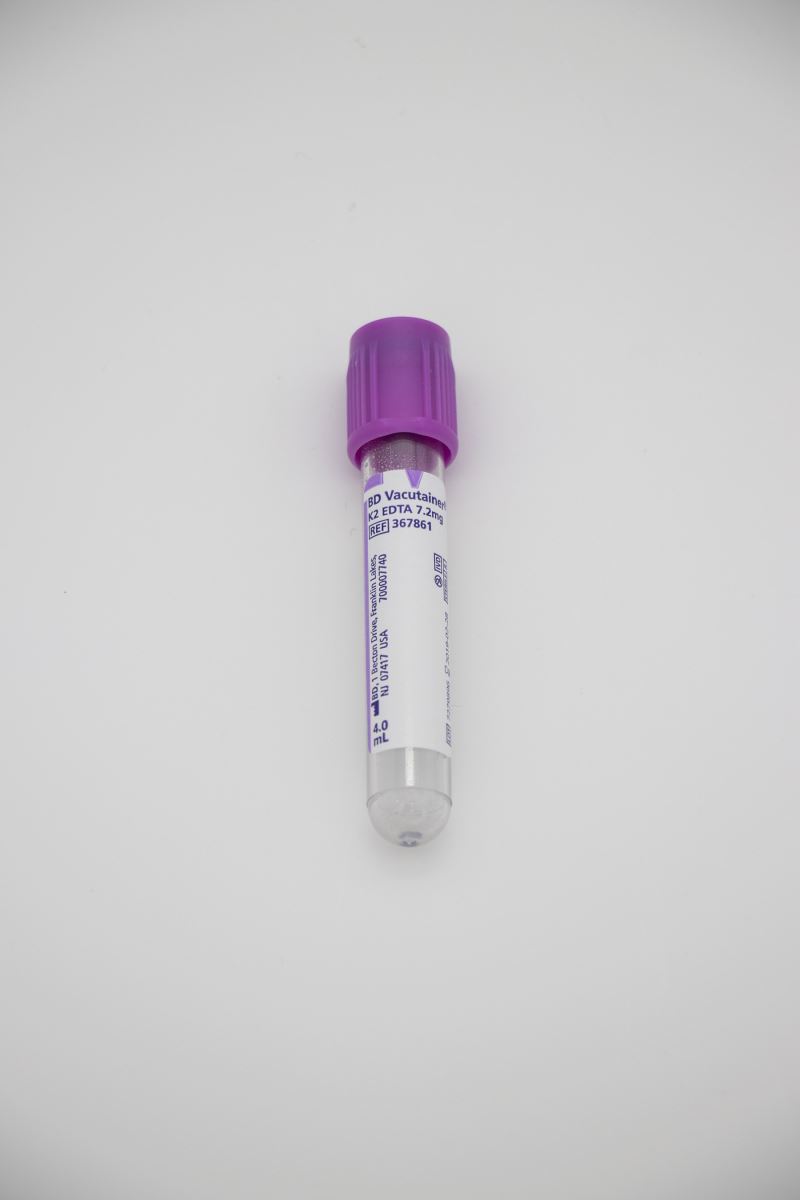
Collect whole blood in a purple top (EDTA) tube (preferred). Bone marrow aspirate, fresh tissue, frozen tissue, or DNA are also acceptable specimens. For germline testing of an individual with a hematological malignancy or status/post bone marrow transplant, testing can be performed on a skin biopsy. This specimen should be submitted as fresh tissue.
Purple (EDTA)
Unacceptable Conditions
Heparinized specimens, severely hemolyzed specimens, frozen, clotted or possibly commingled blood specimens, blood in non-sterile or leaky containers, mislabeled or inappropriately labeled specimens.
Storage/Transport Temperature
For CHOP Phlebotomy: Samples can be collected throughout the week. Samples collected on weekends or holidays are held in Central Labs and sent to the Genomic Diagnostic Lab the following business day.
For External Clients: Send the sample at room temperature (except for frozen tissue) with overnight delivery for receipt Monday through Friday, optimally within 24 hours of collection.
Please contact the lab (267-426-1447) with questions regarding non-blood specimens.
Volume Required
Blood – 3-5mL of blood in an EDTA (purple top) tube.
Bone Marrow Aspirate – For testing on a bone marrow aspirate, 3-5 mL is needed in an EDTA (purple top) tube.
DNA –5-10ug of DNA with a minimum concentration of 50ng/uL.
Fresh or Frozen Tumor Tissue –0.5cm3 of tissue is needed. Please indicate percentage tumor nuclei. Also include a pathology report.
Minimum Required
See Volume Required.
Phlebotomy Draw
Yes
Clinical Features
Germline pathogenic heterozygous variants in the TP53 gene cause Li-Fraumeni syndrome (LFS), a clinically and genetically heterogeneous cancer predisposition syndrome characterized by autosomal dominant inheritance, high penetrance, early onset of tumors, multiple tumors within an individual, and multiple affected family members [OMIM #151623]. Li-Fraumeni syndrome is associated with the development of the following tumors, often in childhood or young adulthood: soft tissue sarcoma, osteosarcoma, pre-menopausal breast cancer, brain tumors, adrenocortical carcinoma (ACC), and leukemias [Schneider 2013, PMID: 20301488].
Somatic mutations in TP53 are recurrently identified in a variety of neoplasms [OMIM *191170]. TP53 is located on chromosome 17p13.1 and encodes a tumor suppressor protein [Gene ID 7157].
Performing Lab
Division of Genomic Diagnostics
Performed
Mon - Fri 9:00am to 4:00pm
Reported
28 days
Detection Rate
At least 70% of individuals with a clinical diagnosis of LFS have an identifiable TP53 variant [Bachinski 2005, PMID: 15695383]. Sequence analysis of the TP53 gene is estimated to detect ~95% of variants; whereas deletion/duplication analysis identifies another ~1% of variants [Malkin 2011, PMID: 21779515; Gonzalez 2009, PMID: 19556618].
Utility
The clinical utility of these assays is to confirm a clinical diagnosis of LFS.
This particular test is for DNA sequence analysis of the TP53 gene. PCR amplification and sequencing is performed on all coding exons including splice junctions. The patient's gene sequence is then compared to a reference sequence. Sequence variants are classified as mutations, variants of uncertain significance or benign variants unrelated to disease. Variants of uncertain significance may warrant further studies in the patient and other family members.
We also offer a combined TP53 sequence analysis and deletion/duplication test as well as a deletion/duplication only test. Please see the other test menu entries for more information.
Molecular Testing Notes
Germline heterozygous pathogenic variants in the TP53 gene located on chromosome 17p13.1 causes autosomal dominant Li-Fraumeni syndrome.
CPT Codes
81351
Collection
Collect
Collect whole blood in a purple top (EDTA) tube (preferred). Bone marrow aspirate, fresh tissue, frozen tissue, or DNA are also acceptable specimens. For germline testing of an individual with a hematological malignancy or status/post bone marrow transplant, testing can be performed on a skin biopsy. This specimen should be submitted as fresh tissue.
Purple (EDTA)
Unacceptable Conditions
Heparinized specimens, severely hemolyzed specimens, frozen, clotted or possibly commingled blood specimens, blood in non-sterile or leaky containers, mislabeled or inappropriately labeled specimens.
Storage/Transport Temperature
For CHOP Phlebotomy: Samples can be collected throughout the week. Samples collected on weekends or holidays are held in Central Labs and sent to the Genomic Diagnostic Lab the following business day.
For External Clients: Send the sample at room temperature (except for frozen tissue) with overnight delivery for receipt Monday through Friday, optimally within 24 hours of collection.
Please contact the lab (267-426-1447) with questions regarding non-blood specimens.
Volume Required
Blood – 3-5mL of blood in an EDTA (purple top) tube.
Bone Marrow Aspirate – For testing on a bone marrow aspirate, 3-5 mL is needed in an EDTA (purple top) tube.
DNA –5-10ug of DNA with a minimum concentration of 50ng/uL.
Fresh or Frozen Tumor Tissue –0.5cm3 of tissue is needed. Please indicate percentage tumor nuclei. Also include a pathology report.
Minimum Required
See Volume Required.
Phlebotomy Draw
Yes
Ordering
Clinical Features
Germline pathogenic heterozygous variants in the TP53 gene cause Li-Fraumeni syndrome (LFS), a clinically and genetically heterogeneous cancer predisposition syndrome characterized by autosomal dominant inheritance, high penetrance, early onset of tumors, multiple tumors within an individual, and multiple affected family members [OMIM #151623]. Li-Fraumeni syndrome is associated with the development of the following tumors, often in childhood or young adulthood: soft tissue sarcoma, osteosarcoma, pre-menopausal breast cancer, brain tumors, adrenocortical carcinoma (ACC), and leukemias [Schneider 2013, PMID: 20301488].
Somatic mutations in TP53 are recurrently identified in a variety of neoplasms [OMIM *191170]. TP53 is located on chromosome 17p13.1 and encodes a tumor suppressor protein [Gene ID 7157].
Performing Lab
Division of Genomic Diagnostics
Performed
Mon - Fri 9:00am to 4:00pm
Reported
28 days
Detection Rate
At least 70% of individuals with a clinical diagnosis of LFS have an identifiable TP53 variant [Bachinski 2005, PMID: 15695383]. Sequence analysis of the TP53 gene is estimated to detect ~95% of variants; whereas deletion/duplication analysis identifies another ~1% of variants [Malkin 2011, PMID: 21779515; Gonzalez 2009, PMID: 19556618].
Utility
The clinical utility of these assays is to confirm a clinical diagnosis of LFS.
This particular test is for DNA sequence analysis of the TP53 gene. PCR amplification and sequencing is performed on all coding exons including splice junctions. The patient's gene sequence is then compared to a reference sequence. Sequence variants are classified as mutations, variants of uncertain significance or benign variants unrelated to disease. Variants of uncertain significance may warrant further studies in the patient and other family members.
We also offer a combined TP53 sequence analysis and deletion/duplication test as well as a deletion/duplication only test. Please see the other test menu entries for more information.
Molecular Testing Notes
Germline heterozygous pathogenic variants in the TP53 gene located on chromosome 17p13.1 causes autosomal dominant Li-Fraumeni syndrome.