

Collect

Acceptable: Serum (SST)
 

Specimen Preparation

Allow serum samples to clot at room temperature for a minimum of 20 minutes. Separate serum from cells ASAP or within 2 hours of collection. (Min volume: 0.5mL)

Unacceptable Conditions

Body fluids. Contaminated, hemolyzed, or severely lipemic specimens.

Storage/Transport Temperature

Room Temperature - 72 hours
Refrigerated- 7 days

Stability (from collection to initiation)


Room Temperature - 72 hours
Refrigerated- 7 days
After removed plasma from the tube- -10°C or colder- 30 days

Cerner Orderable(s)

Orderable name: Syphilis Screening Test (Treponema Ab reflex to RPR reflex to TP-PA)


Performed

Morton Plant Hospital and  St. Joseph's Hospital.
24/7

Ordering Recommendations


The Syphilis Screening Test, Treponema Antibody is the initial test in the cascade.
(Treponema Antibody (TPA) reflex to RPR reflex to TP-PA).


Methodology

Antigen Sandwich assay with direct chemiluminometric technology.

Reported

Within 24 hours.

Synonyms

  • Syphilis Screening Test
  • T pallidum IgG ELISA
  • Syphilis Antibody, IgG by ELISA

Reference Interval

Reference Interval
<1.00 - Negative - 
No significant level of Treponema Pallidum IgG and IgM antibodies was detected.


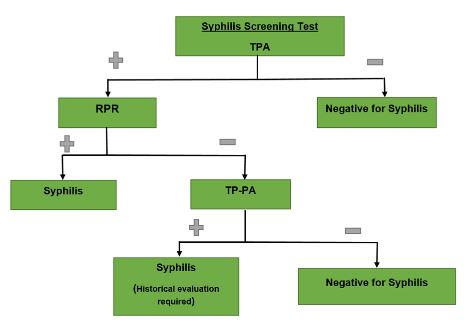
Reflex Algorithm

Interpretive Data

<1.00 - Negative- No serologic evidence of Syphilis infection 
≥ 1.00 - Positive - Reported as reactive presumptive 


  • Samples negative by Treponema pallidum Antibody (TPA) are reported as Negative.
  • Positive Treponema pallidum Antibody (TPA) samples are reported as reactive presumptive and are confirmed by RPR within 24 hours to assess disease activity. 
    •  If the RPR result is reactive, this is: Consistent with current or past Syphilis infection (untreated or recently treated Syphilis). Follow-up with RPR titer is recommended to assess response to therapy. 
    • Discordant Treponema pallidum Antibody (TPA) and RPR results are resolved as per CDC guidelines by a second Treponema pallidum Antibody specific test  (TP-PA) to confirm the initial Treponema pallidum Antibody (TPA) screen.
      • "Treponema pallidum Antibody (TPA) reactive presumptive, RPR negative, TP-PA negative result is consistent with low likelihood of Syphilis; if recent exposure is suspected, order RPR titer in 2-4 weeks."
      • "If a Treponema pallidum Antibody (TPA) reactive presumptive, RPR negative, TP-PA indeterminate result is obtained, please collect a fresh sample in 2 weeks and re-order the TPA test, if clinically indicated."
      • "A Treponema pallidum Antibody (TPA) reactive presumptive, RPR negative, TP-PA positive result is consistent with past (successfully treated or latent) or potential early Syphilis infection." 
If the patient is at risk for the recent acquisition of Syphilis, reorder the Syphilis Screening Test in one month. Seroconversion between acute and convalescent sera is considered strong evidence of recent infection. The best evidence for infection is a significant change in two appropriately timed specimens, where both tests are performed in the same laboratory at the same time. 

CPT Codes

86780
Collection

Collect

Acceptable: Serum (SST)
 

Specimen Preparation

Allow serum samples to clot at room temperature for a minimum of 20 minutes. Separate serum from cells ASAP or within 2 hours of collection. (Min volume: 0.5mL)

Unacceptable Conditions

Body fluids. Contaminated, hemolyzed, or severely lipemic specimens.

Storage/Transport Temperature

Room Temperature - 72 hours
Refrigerated- 7 days

Stability (from collection to initiation)


Room Temperature - 72 hours
Refrigerated- 7 days
After removed plasma from the tube- -10°C or colder- 30 days
Ordering

Cerner Orderable(s)

Orderable name: Syphilis Screening Test (Treponema Ab reflex to RPR reflex to TP-PA)


Performed

Morton Plant Hospital and  St. Joseph's Hospital.
24/7

Ordering Recommendations


The Syphilis Screening Test, Treponema Antibody is the initial test in the cascade.
(Treponema Antibody (TPA) reflex to RPR reflex to TP-PA).


Methodology

Antigen Sandwich assay with direct chemiluminometric technology.

Reported

Within 24 hours.

Synonyms

  • Syphilis Screening Test
  • T pallidum IgG ELISA
  • Syphilis Antibody, IgG by ELISA
Result Interpretation

Reference Interval

Reference Interval
<1.00 - Negative - 
No significant level of Treponema Pallidum IgG and IgM antibodies was detected.


Reflex Algorithm

Interpretive Data

<1.00 - Negative- No serologic evidence of Syphilis infection 
≥ 1.00 - Positive - Reported as reactive presumptive 


  • Samples negative by Treponema pallidum Antibody (TPA) are reported as Negative.
  • Positive Treponema pallidum Antibody (TPA) samples are reported as reactive presumptive and are confirmed by RPR within 24 hours to assess disease activity. 
    •  If the RPR result is reactive, this is: Consistent with current or past Syphilis infection (untreated or recently treated Syphilis). Follow-up with RPR titer is recommended to assess response to therapy. 
    • Discordant Treponema pallidum Antibody (TPA) and RPR results are resolved as per CDC guidelines by a second Treponema pallidum Antibody specific test  (TP-PA) to confirm the initial Treponema pallidum Antibody (TPA) screen.
      • "Treponema pallidum Antibody (TPA) reactive presumptive, RPR negative, TP-PA negative result is consistent with low likelihood of Syphilis; if recent exposure is suspected, order RPR titer in 2-4 weeks."
      • "If a Treponema pallidum Antibody (TPA) reactive presumptive, RPR negative, TP-PA indeterminate result is obtained, please collect a fresh sample in 2 weeks and re-order the TPA test, if clinically indicated."
      • "A Treponema pallidum Antibody (TPA) reactive presumptive, RPR negative, TP-PA positive result is consistent with past (successfully treated or latent) or potential early Syphilis infection." 
If the patient is at risk for the recent acquisition of Syphilis, reorder the Syphilis Screening Test in one month. Seroconversion between acute and convalescent sera is considered strong evidence of recent infection. The best evidence for infection is a significant change in two appropriately timed specimens, where both tests are performed in the same laboratory at the same time. 
Administrative

CPT Codes

86780